


Technical Articles · Replacement Windows
You need a replacement window for a machine or equipment cab, but the original drawing is unavailable. You may have photographs, a glass panel, a part number or access to the frame. Where should you start?
In this guide
Begin with the information you already have. The first review should identify the required panel, the reference available for its geometry and the conditions it needs to meet. The remaining details can then be gathered for quotation and manufacturing preparation.
Start the discussion with what you have. Establish a reliable dimensional reference before production.
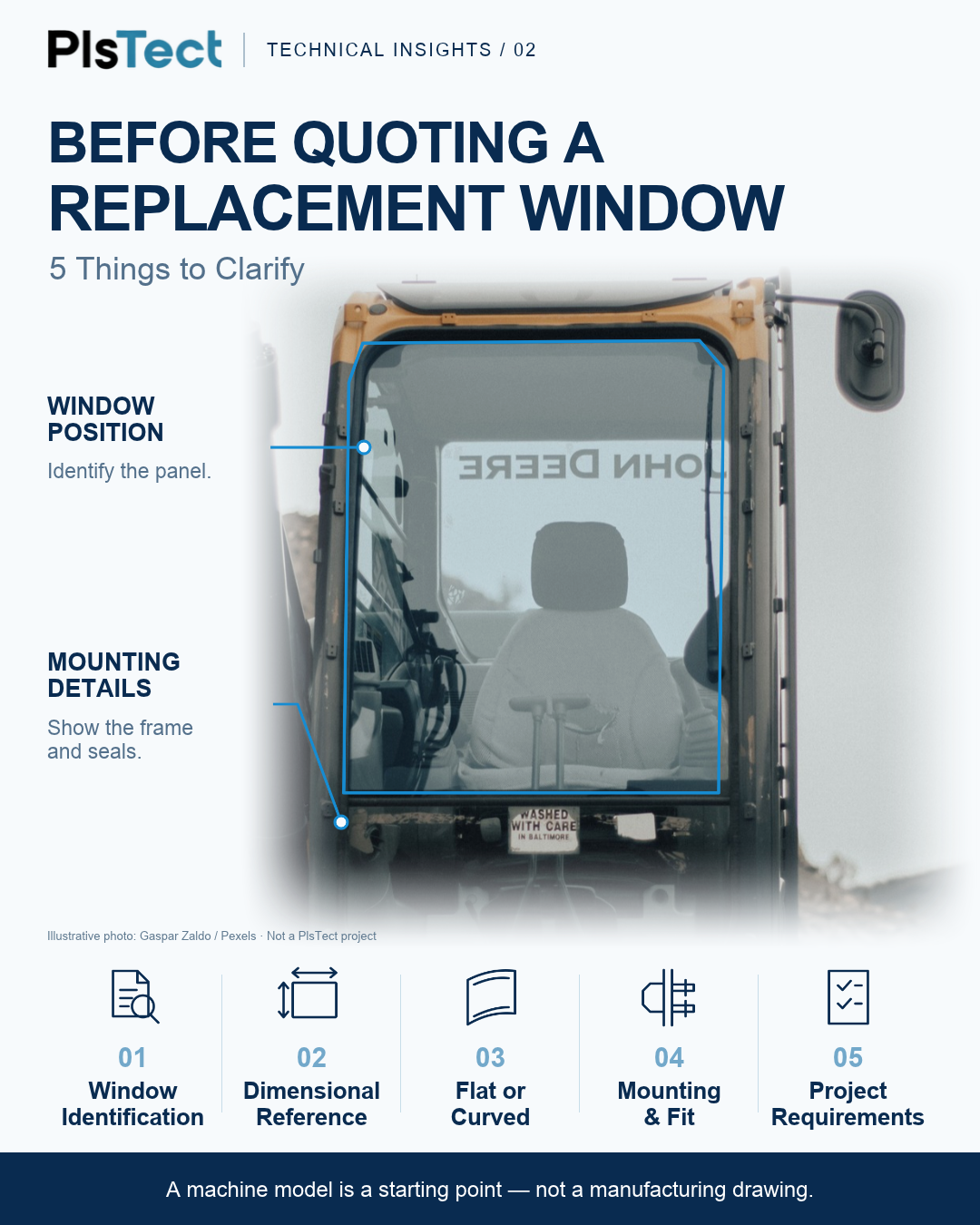
1. Choose the best reference you can provide
A machine model and window position help identify the request. For a custom replacement that has not already been verified, the manufacturer also needs a reliable way to establish the actual part geometry.
Different references answer different questions:
| Available reference | What it can help establish | What still needs checking |
|---|---|---|
| OEM or existing drawing | Outline, dimensions, holes and specified tolerances. | Units, revision and whether the drawing matches the panel currently installed. |
| Original glass or plastic panel | Physical outline, curvature, edge features and mounting positions. | Damage or distortion, plus any intended changes to material, thickness or installation. |
| Full-size template of a flat panel | A two-dimensional outline and clearly marked hole positions. | Scale, dimensional checks, orientation, thickness and which physical edge was traced. |
| 3D CAD or scan data | Curved surface geometry and its relationship to mounting features. | Units, accuracy, completeness and correspondence with the actual part. |
| Frame, seals and hardware | How the panel is supported, retained and sealed. | The full panel geometry and required clearances; the visible opening alone may be insufficient. |
| Photographs and approximate measurements | Panel identification, overall size and an initial view of the project. | Verified manufacturing geometry, including details hidden by the frame or seals. |
If you only have the original glass, it can still be useful. It may provide the physical reference for a proposed plastic replacement. The new material and installation requirements should be reviewed alongside that geometry.
2. Five things to clarify before quotation
Organise your enquiry around these five areas. Mark information as confirmed, approximate or unknown so the first review can focus on what needs attention.
01 — Window identification
Provide the equipment make and model, serial number or production year if available, and the exact window position. Include any OEM glass or part number and a photograph with the required panel highlighted.
For multiple panels, assign a simple identifier to each one and use it consistently on photographs, measurements and quantity lists. State how left and right are defined, for example from the operator’s position.
02 — Dimensional reference
Tell us whether you can provide a drawing, original panel, full-size template or validated digital geometry. Add the dimensions and thickness you know, with units. If a flat template is the agreed reference, follow our full-size cardboard template guide for preparation and dimensional checks.
Distinguish the complete panel perimeter from the visible opening in the frame. A panel may extend behind a retainer or into a seal. An opening measurement therefore needs to be identified as an opening measurement.
If the original part is broken or incomplete, identify the missing areas. A damaged sample may still provide useful information, but it may not define the entire replacement.
03 — Flat or curved
Describe whether the panel is flat, has a single-direction bend or has a more complex curved surface. Front, side and angled photographs help communicate the shape.
A verified flat template can help define a flat panel’s outline. A curved window also needs appropriate curvature information, reliable 3D data or a physical reference. A flat outline or one height measurement does not fully describe an arbitrary curved surface.
For a fuller measurement plan, see what to record for flat and curved replacement windows, including the outline, mounting features and installed shape.
If you are unsure, send the available views first. The next step is to establish what additional geometry is needed.
04 — Mounting and fit
Show how the panel is retained: rubber gasket, adhesive, bolts, clamps, hinges, sliding channel or another arrangement. Include close-up photographs of the relevant edges, seals and hardware.
Useful details include the original thickness, hole and slot sizes and positions, edge treatment, mounting clearances and which face is inside or outside. Identify any bonding area or coating requirement on that face.
When replacing glass with polycarbonate, review the selected thickness and mounting arrangement together. Thermal movement also needs consideration; polycarbonate expands more than glass as temperature rises. The appropriate allowance depends on the material, panel and installation. [1]
If you are changing from glass to PC, review the thickness, mounting and surface checks for a polycarbonate replacement alongside the quotation information.
05 — Project requirements
Explain what the replacement needs to achieve and how many pieces are required. Include the quantity for each panel and distinguish a sample order from an expected production batch.
Relevant requirements may include outdoor exposure, impact conditions, abrasion from cleaning or wipers, optical clarity, tint, chemical contact and any specified finished-product testing. Describe the current problem if the aim is to improve an existing window.
Also clarify the requested supply form: coated sheet for your own processing, a cut or machined panel, or a formed component. This helps align the quotation with the work you actually need.
3. Take photographs that explain the part and its installation
A focused set of photographs can make the first discussion more productive:
- Equipment overview: show where the window sits on the machine.
- Panel view: show the complete visible shape and highlight the required window.
- Side or angled view: show curvature, edge shape and the relationship to the frame.
- Mounting details: show seals, holes, hinges, clamps or bonding areas.
- Identification and condition: show any part marking and areas that are damaged, missing or modified.
Written dimensions should state their start and end points and units. A ruler in a photograph provides context, but camera perspective makes the photograph an unreliable substitute for a verified drawing or physical reference.
4. Separate initial review, quotation and production preparation
The information needed increases as the project becomes more defined. A practical way to organise the work is:
| Project stage | Useful information | Expected outcome |
|---|---|---|
| Initial review | Panel identification, photographs, approximate size, application, quantity and available references. | Identify a possible supply route and the information still needed. Where feasible, an indicative estimate can be discussed against stated assumptions. |
| Formal quotation | A sufficiently defined part and scope: geometry or an agreed reference, material, thickness, coating, processing, quantity and relevant validation requirements. | A quotation stating its technical and commercial basis, with any remaining assumptions or exclusions identified. |
| Production preparation | An agreed manufacturing definition, critical dimensions and tolerances, material and coating specification, mounting requirements, and the required approval or sample checks. | A controlled basis for manufacture and acceptance of the replacement part. |
A customer-supplied drawing is one route to this definition. An original part or a verified template may also support the preparation of manufacturing data, depending on the geometry and project.
Confirm whether measurement, geometry reconstruction, tooling or sample development is included in the project scope. These steps should be agreed before treating an early estimate as the final production price.
5. What if you have no drawing and no sample?
Send the equipment details, the exact panel position and the best available photographs. Then explain what you can access: the machine, an intact matching panel, its frame, a dealer’s parts information or an OEM replacement part.
Possible next steps include obtaining the correct drawing or original part, arranging measurements from a suitable reference, or preparing a verified template for a flat panel. A curved panel may need a physical reference or appropriate three-dimensional measurement.
If no reliable reference can be obtained, the part geometry remains unresolved. The project can be discussed, but a new custom window cannot be released for manufacture from a model name and general photographs alone.
6. Information to include in your enquiry
Copy the list below into your message and complete what you know. Leave uncertain items marked “to be confirmed”.
Equipment: make, model, serial number or year
Required panel: position, identifier and part number if available
Available reference: drawing, original glass/plastic panel, template, CAD/scan data or frame
Geometry: approximate dimensions, units, thickness and flat/curved description
Installation: seals, adhesive, holes, hardware and inside/outside orientation
Material and surface: existing material and requested change or coating requirement
Application: use environment, current problem and performance or validation requirements
Supply and quantity: required processing level, pieces per panel and sample/batch quantities
Attachments: labelled photographs, measurements and available files
Frequently asked questions
Can I start an enquiry with only a machine model?
Yes. Add the window position and photographs so the request can be identified. For a new custom part, additional information will be needed to establish geometry and manufacturing scope.
Can the original glass be used to develop a polycarbonate replacement?
It can provide a useful physical reference. Material selection, thickness, mounting, optical needs and application-specific validation still need to be agreed for the replacement.
Is a full-size cardboard template enough?
It can help establish the outline and marked holes of a flat panel when its dimensions and orientation are checked. Thickness and installation details must accompany it. It does not provide the full surface geometry of a curved window.
Can I send a sample immediately?
Send photographs and a description first, and agree on the reference to be supplied, delivery details and suitable packing before dispatch.
Discuss your replacement window project
Share the required panel, available drawing, sample or template, and the conditions it needs to meet. PlsTect can review the material, coating and fabrication questions together and identify the next information needed.
Related PlsTect support: Engineering Support · Industrial Equipment Windows & Transparent Panels · Formed Windshields & Windscreens