

Technical Articles · Anti-Fog Polycarbonate
How Long Does Anti-Fog Performance Last After Repeated Cleaning?
A steam demonstration shows current function, not cleaning life. PlsTect reviews condensation, rinsing and wiping against the way the finished part will actually be used.
In this guide
In this guide
An anti-fog surface can look convincing over steam and still leave an important procurement question unanswered: what happens after the part has been cleaned again and again?
There is no useful universal number.
A helmet visor, protective lens, instrument cover and industrial viewing window may all use an anti-fog surface, but they are not exposed or maintained in the same way. Some parts experience frequent condensation and only occasional cleaning. Others are rinsed, wiped or cleaned with a liquid several times during use.
The more useful question is not simply how many cleaning cycles an anti-fog coating can survive. It is whether the selected material or finished part can retain acceptable anti-fog and optical performance under the cleaning routine expected in the real application.
A Steam Demonstration Shows Current Function, Not Cleaning Life
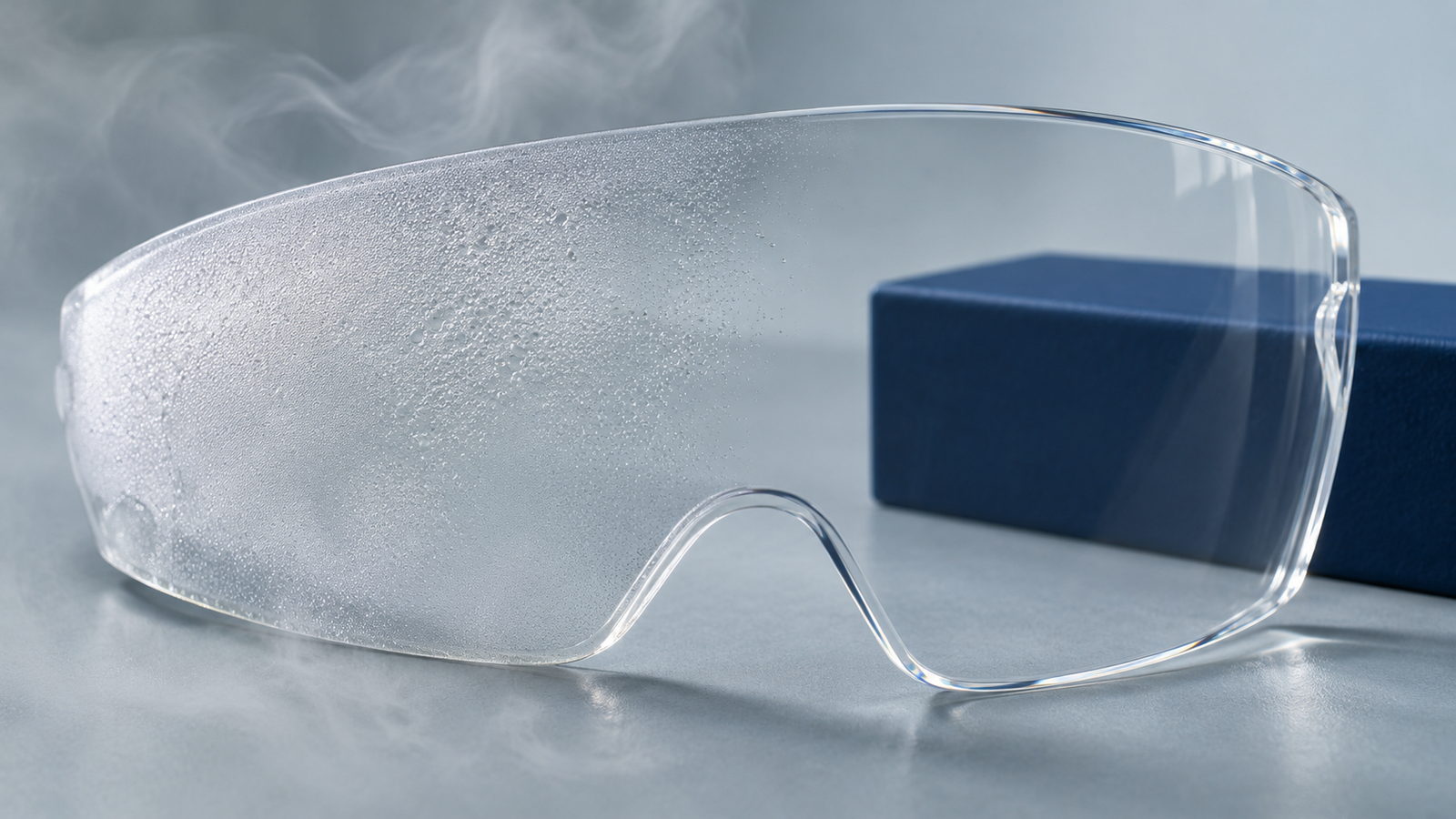
A steam or condensation demonstration is useful. It can show whether the surface is controlling condensation at that moment and whether the viewing area remains clear enough under the selected exposure.
It can also help compare an untreated area with an anti-fog surface, or check whether a sample still responds after forming or another production step.
What it cannot establish by itself is service life.
One successful demonstration does not show how the same surface will behave after repeated wet-and-dry cycles, water rinsing, contact with a cleaner or mechanical wiping. It does not define a guaranteed number of cleanings, and it does not automatically confirm that haze, transparency and surface appearance will remain acceptable.
This does not make the steam test unimportant. It makes it a baseline: the surface is working in this condition, on this sample, at this stage.
Durability begins with what happens next.
Condensation, Rinsing and Wiping Are Different Exposures
Repeated condensation mainly asks whether the surface can continue managing water after multiple fogging and drying events. The coating is repeatedly exposed to moisture, but there may be little physical contact.
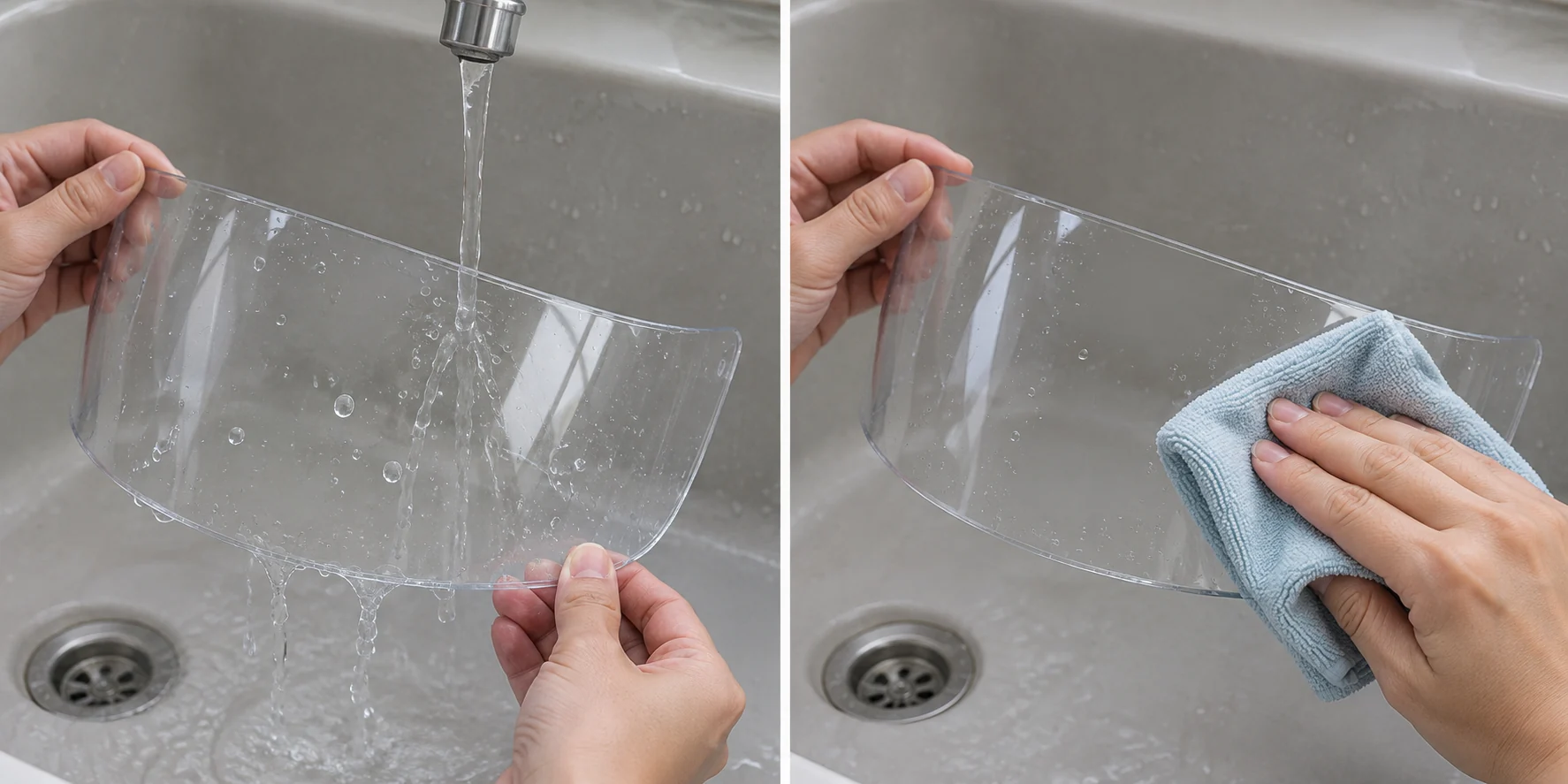
Water rinsing adds longer or more direct water exposure. It may remove loose contamination or residue, but it normally introduces much less abrasion than wiping.
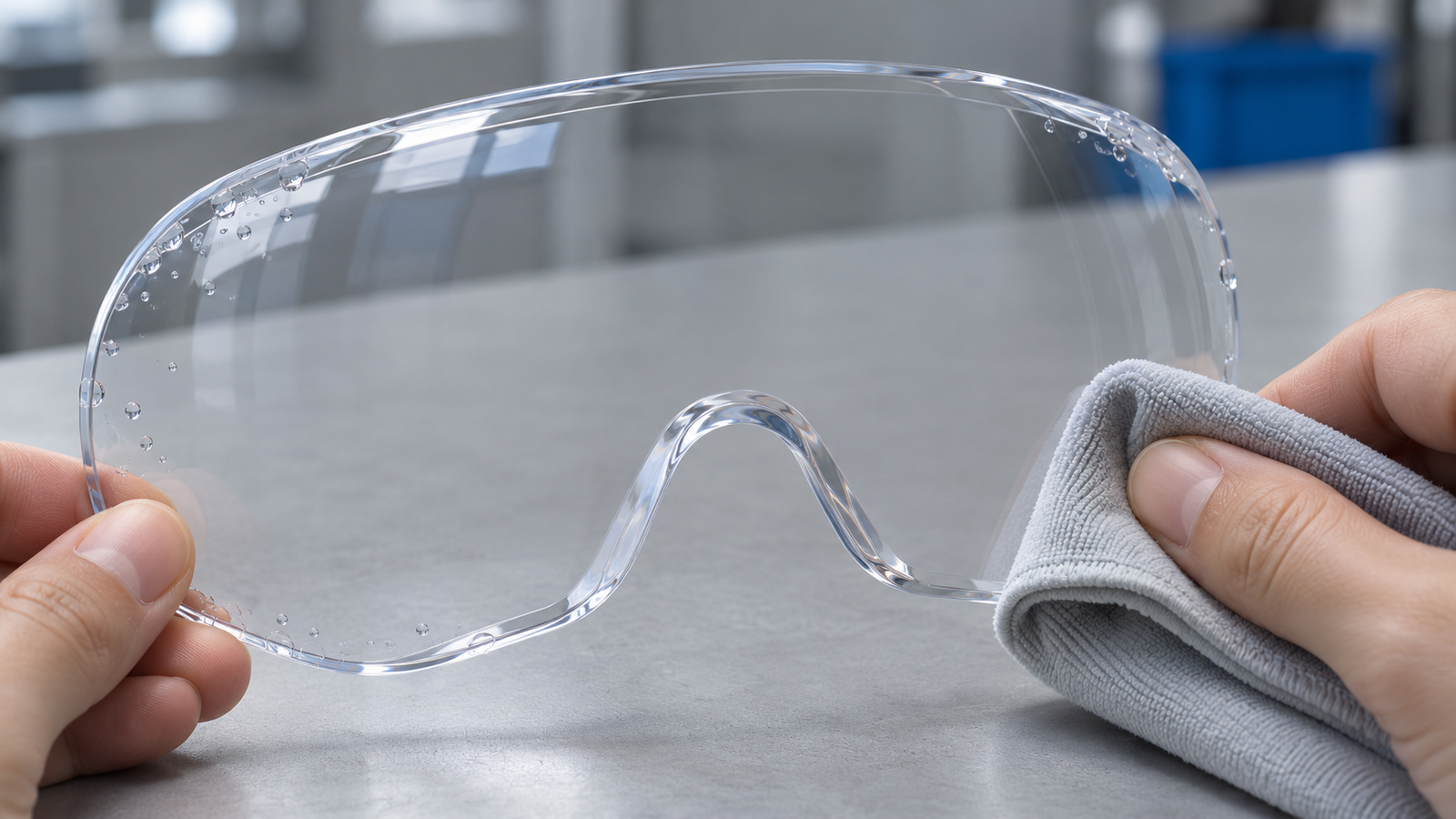
Wiping combines surface contact with movement. The result can change with the cloth or tissue, contact pressure, direction, number of passes and whether dust or particles are present. Dry wiping and wet wiping should not be treated as equivalent.
A cleaning liquid adds another variable. Water, mild detergent and alcohol-based cleaner should not be assumed to interact with every anti-fog construction in the same way. Even where the coating remains visibly intact, residue left on the surface may change how water spreads and make the next fogging check look different.
This is why a surface that tolerates repeated condensation may not respond the same way to frequent dry wiping. A material that handles water rinsing may still need separate consideration when a cleaner and cloth are used together.
All three exposures can be relevant, but they answer different questions.
For PlsTect anti-fog PC surfaces, use a clean, soft, smooth, non-abrasive microfiber lens cloth, such as a suitable eyeglass-cleaning cloth. Avoid coarse-textured fabrics, abrasive tissues, or cloths carrying dust or grit. If wiping is necessary, apply very light pressure and wipe gently in one direction where possible; avoid repeated back-and-forth rubbing. Frequent wet wiping or forceful wiping is not recommended.
Avoid wiping the coated surface while it is wet from condensation, rinsing, or other moisture exposure. Some hydrophilic anti-fog coatings can become more susceptible to mechanical damage after prolonged contact with water. Allow the surface to air-dry completely; as a conservative PlsTect care recommendation, wait approximately two additional hours after it has fully dried before any necessary gentle wipe. This is a handling precaution, not a universal coating recovery time or a standardized durability claim.
A Useful Durability Requirement Starts With Actual Use
A cycle count can sound precise while describing very little.
A statement such as “500 wipes” is only meaningful when the wiping material, cleaner, pressure, movement and acceptance criteria are known. If those conditions do not resemble the application, the number may not help a buyer compare materials.
The procurement team does not need to design a laboratory method before discussing the project. A clear description of normal use is a better starting point:
- what causes the fogging;
- how often the surface becomes wet;
- whether it is normally rinsed, wiped or both;
- what cloth, tissue or cleaning liquid is used;
- which side carries the anti-fog function;
- and what change would be unacceptable.
That last point matters.
For one application, failure may mean visible fogging that blocks the viewing area. For another, the anti-fog response may remain acceptable while haze, cleaning marks or optical clarity become the limiting issue.
“Still working” therefore needs to be connected to the finished part. Anti-fog response, transparency and surface condition may all be part of the approval decision.
A coating can remain visually intact while its anti-fog performance has already changed. Conversely, cleaning residue or temporary moisture uptake may influence the immediate result without necessarily indicating permanent damage. Where relevant, the surface should be evaluated again after an appropriate rinsing and drying procedure.
A flat sample can support an initial comparison, but the delivered component may be curved, trimmed, printed, bonded or assembled. Its anti-fog side may also be harder to access and clean evenly.
A helmet visor, for example, may receive repeated breath condensation on the inner surface, while fingerprints or dust affect how that surface is wiped. An industrial viewing part may be cleaned less often but exposed to a different combination of water, residue and handling.
The relevant evaluation should follow the way the finished part will actually be used.
How PlsTect Defines a Representative Sample Route
PlsTect does not convert one successful steam demonstration into a universal lifetime claim, and it does not ask the customer to choose a cleaning-cycle number without context.
The review begins with the application, delivery form, coated side and normal maintenance routine.
From that information, PlsTect can define what a representative sample needs to reproduce, which exposures are relevant and which changes should be compared before and after the selected condition.
Depending on the project, the review may focus on repeated condensation, water exposure, wiping or a combination that reflects normal use. Anti-fog response may be considered together with surface appearance, haze, transparency or other agreed acceptance points.
Where cleaning durability is being evaluated, comparing the anti-fog response before and after a defined cleaning routine under the same fogging conditions helps distinguish initial performance from retained performance. A defined drying or recovery step may also be relevant.
The scope should remain proportionate to the application. A lightly handled component should not automatically receive the same cleaning review as a reusable lens that is wiped several times during a shift.
The supply form also matters. A coated sheet intended for further processing may need to be considered together with forming, masking and handling. A finished visor or transparent component can be reviewed in its final geometry, with the coated side and maintenance routine already defined.
The purpose is not to create the longest possible test list. It is to identify the conditions that can change the real product and to clarify, before production:
- what the sample has represented;
- which cleaning and moisture conditions were considered;
- what remained acceptable;
- and which changes in use, cleaner or process would require further review.
This gives the buyer a defined project boundary instead of an unsupported promise that the anti-fog effect is simply “long-lasting.”
Ask a Better Procurement Question
Instead of asking only:
How many times can this anti-fog coating be cleaned?
Ask:
Under our normal condensation and cleaning routine, what should be evaluated before we approve the material or finished part?
That question gives the supplier enough context to recommend a relevant route and gives the buyer a clearer basis for comparing samples.
Two anti-fog products should not be judged only by their first steam demonstration if one application involves regular wiping and the other is mainly exposed to repeated condensation.
The useful answer is not the largest cycle count. It is a sample evaluation that represents the application, checks the right properties and defines what has actually been confirmed.
Review the Cleaning and Use Conditions
Share the application, coated side, expected fogging condition and normal cleaning method.
PlsTect will review how the material, delivery form and representative sample can be aligned with the intended use—without treating an initial fogging demonstration as a universal service-life claim.