

Technical Insights
UV Blocking vs. Weathering: What Windshield Buyers Should Check
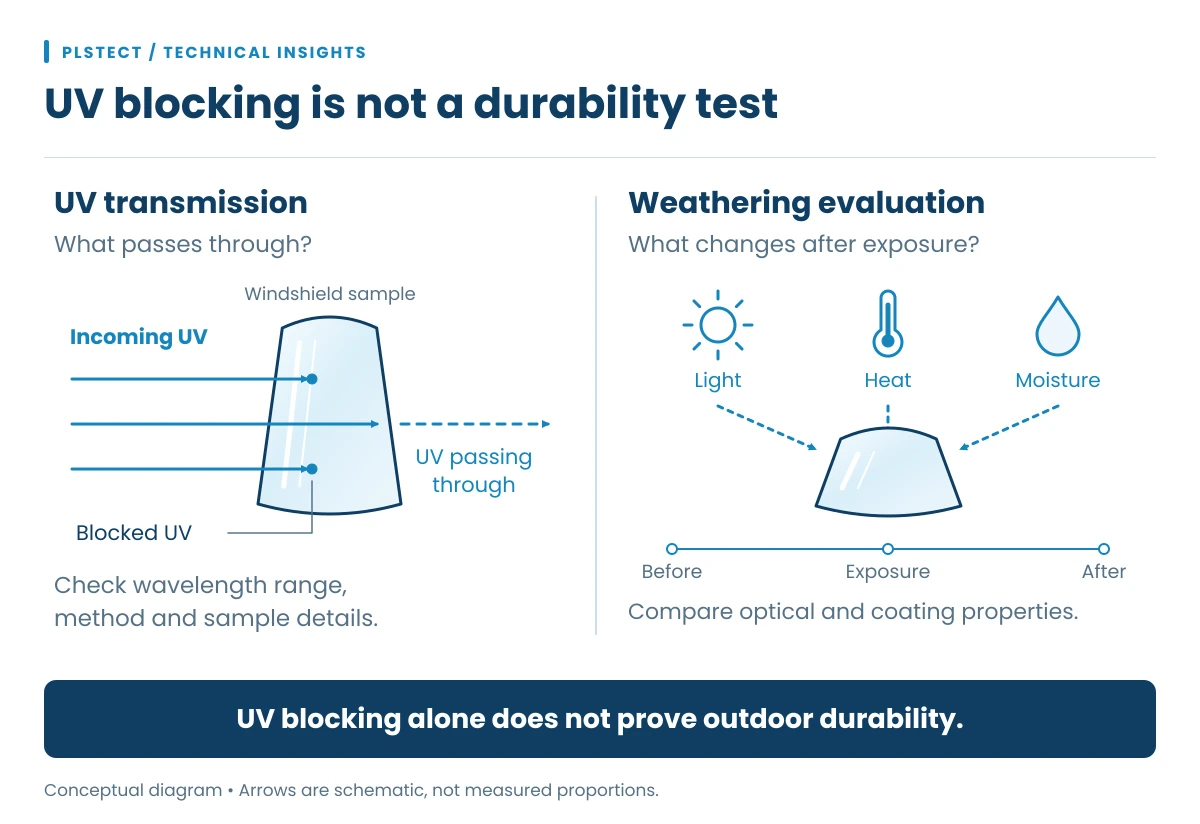
When selecting a material for an outdoor windshield, ask two questions: how much ultraviolet radiation passes through the panel, and how its performance changes after exposure.
A UV transmission result addresses the first question. A weathering evaluation addresses the second. A useful specification identifies both the optical requirement and the properties the finished part needs to retain.

In this guide
UV blocking alone does not prove outdoor durability.
1. Two questions, different evidence
| What to compare | UV transmission | Weathering evaluation |
|---|---|---|
| Main question | How much UV passes through this sample? | How does this sample change after exposure? |
| Useful evidence | A transmission spectrum or a defined UV transmission result. | Measurements and observations before exposure and at specified intervals. |
| Essential context | Wavelength range, measurement method and sample specification. | Light source, exposure cycle, temperature, moisture conditions and evaluation criteria. |
| What it establishes | Optical behaviour of the tested sample in its measured condition. | Changes in the evaluated properties under the stated exposure conditions. |
The two evaluations can be used together. UV transmission can also be measured again after weathering when retaining UV-blocking performance is part of the project requirement. [1] [2] [3]
2. Read a UV-blocking claim with its measurement details
UV transmission is wavelength-dependent. When a supplier provides a single UV-blocking percentage, ask which wavelength range it covers and how that percentage was calculated. A result at one wavelength and an average across a band describe different things. [1]
For a windshield project, request the sample thickness, material grade, tint and coating configuration alongside the result. Also identify whether the measurement was taken before or after forming, and before or after environmental exposure. This helps establish whether the supplied data represents the part being considered.
Keep UV transmission and visible light transmission clearly labelled in the specification. They concern different spectral regions and answer different purchasing questions. [1]
3. Weathering evaluation measures what changes
Outdoor-facing materials encounter light, heat and moisture. Laboratory weathering uses defined exposure conditions to investigate associated property changes; the selected method and operating conditions determine what has been evaluated. [2]
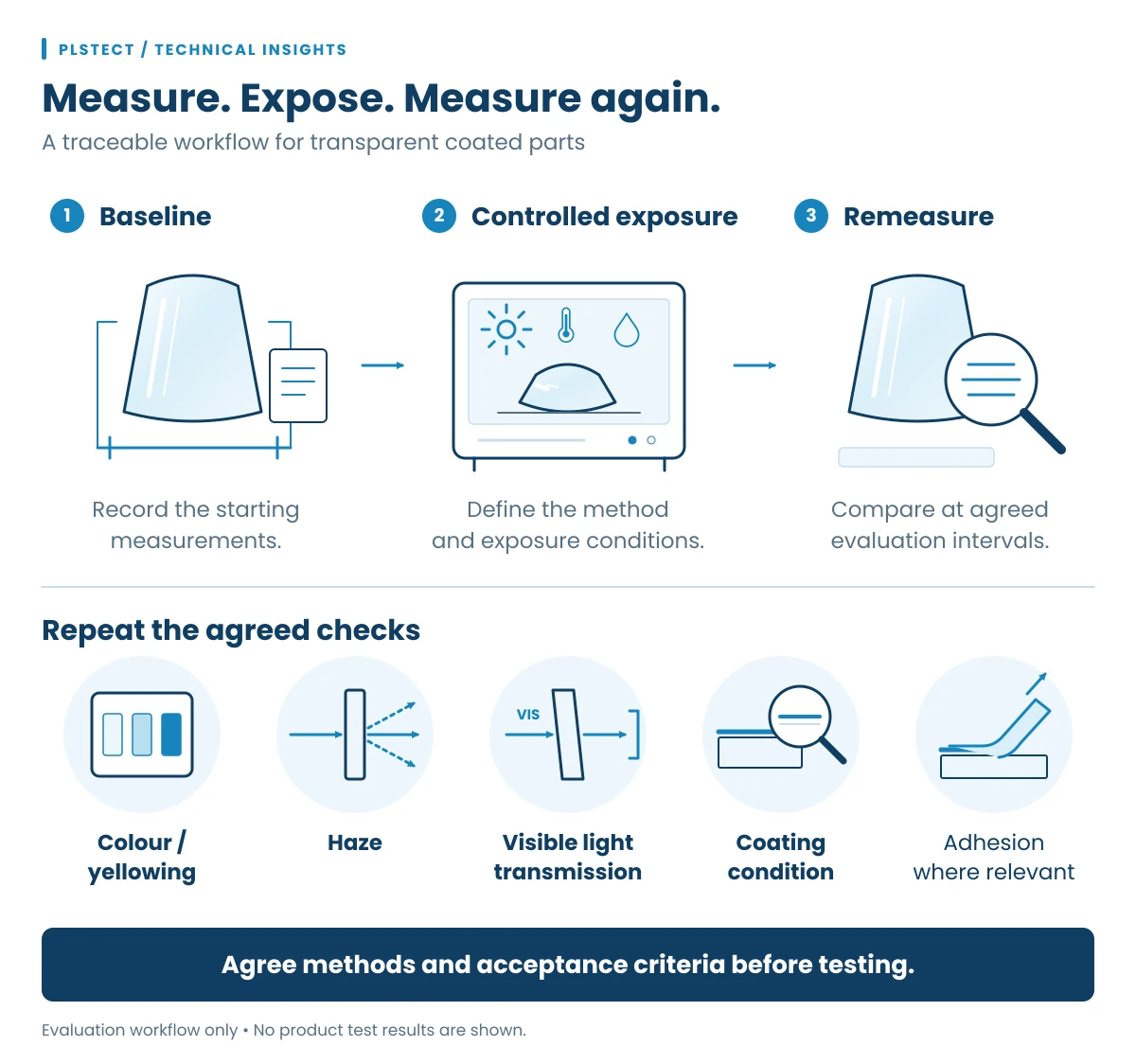
For transparent coated parts, agree on the properties to measure before testing starts. Useful checks may include:
| Property | What to compare before and after exposure |
|---|---|
| Colour or yellowing | Instrumental colour or yellowness measurements using the same defined method and settings. |
| Haze | Haze readings, with the method and specimen preparation recorded. |
| Visible light transmission | Transmission readings using the same stated measurement basis. |
| Coating condition | Changes such as cracking, blistering or peeling, assessed under consistent inspection conditions. |
| Adhesion | Results from an appropriate, agreed adhesion test, where relevant to the coating and substrate. |
Baseline readings and scheduled evaluations make changes traceable. Photographs provide useful supporting context, while instrumental measurements and defined inspection criteria make the assessment more repeatable. [3] [4]
Specimen geometry also matters. For example, ASTM D1003 covers planar sections of transparent materials. If the product is curved, agree with the laboratory how representative specimens will be prepared and what additional finished-part checks are needed. [4]
4. Exposure hours need a test method and results
A test duration describes how long an exposure ran. To assess the result, read it with the light source, cycle, temperatures, moisture conditions, sample construction and measured changes.
There is no universal multiplier that converts accelerated weathering hours into years outdoors. The relationship depends on the material, laboratory conditions and actual exposure environment. Any project-specific correlation needs validation against relevant outdoor exposure or service data for the same material system and defined laboratory conditions. [5]
When comparing reports, first check whether their conditions and evaluation methods are comparable. A longer exposure in a different test does not by itself establish better outdoor durability. [2] [5]
5. What to request before approving a windshield material
Use this checklist when discussing the evaluation with your supplier:
- Identify the specimen. Record the substrate, grade, thickness, tint, coating arrangement, exposed side and manufacturing stage.
- Define the UV requirement. State the wavelength range and the measurement or calculation method.
- Define the exposure. Record the applicable method, light source, operating cycle, temperature, moisture conditions and duration.
- Request the starting and final results. Include the agreed optical and coating checks, with interim readings where useful.
- Agree on acceptance criteria. Specify which changes are acceptable for the application and what further finished-part validation is needed.
For coated windshields, also identify the manufacturing route represented by the specimen. A pre-coated sheet used for subsequent forming and a part coated after forming should each be evaluated in a way that reflects the intended delivered product. PlsTect discusses these routes alongside geometry, material and application requirements.
When choosing that manufacturing route, compare pre-coated and post-form hard coating against the part geometry, required coating coverage and intended delivery form.
For a formed windshield, use the formed windshield validation guide to connect geometry, local thickness, viewing quality and coating checks with the sample being approved.
Discuss your outdoor windshield project
Share the intended use, material, thickness, drawing or sample, coating route and properties that need to be retained. PlsTect can help review the material and coating direction, together with the validation questions for your project.
Related PlsTect support
- Weather-Resistant Surface Solutions — review outdoor surface and material requirements.
- Quality Proofing — explore performance validation and process control.
- Formed Windshields & Windscreens — connect coating selection with geometry, forming and final-part review.
Technical references
- Shimadzu — UV-3600i Plus applications. Spectral transmission and related optical calculations.
- ASTM D4329-26 — Fluorescent Ultraviolet Lamp Apparatus Exposure of Plastics. Public scope and significance of the exposure practice.
- Q-Lab — Evaluations. Baseline measurements, interval evaluations and inspection methods.
- ASTM D1003-21 — Haze and Luminous Transmittance of Transparent Plastics. Public scope and significance of the optical measurement method.
- Q-Lab — How many hours in a Q-SUN or a QUV equals a year of outdoor exposure?