

Technical Articles · Anti-Fog Polycarbonate
For manufacturers already producing curved polycarbonate parts, adding anti-fog functionality should not necessarily mean changing the way they manufacture their products.
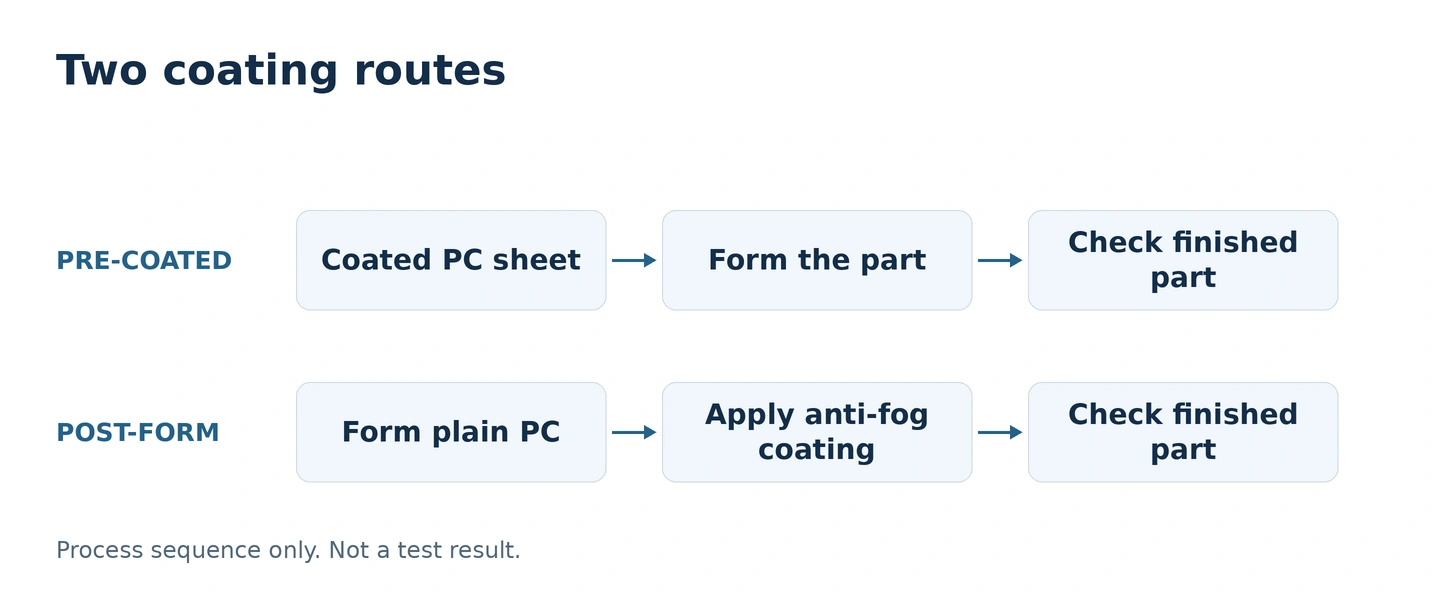
If pre-coated anti-fog PC sheets can be processed using existing equipment, there may be no need to introduce a separate coating operation. The manufacturer can continue cutting, forming and finishing the material using a familiar production process.
That is why we generally recommend looking at pre-coated sheets first, especially for OEM manufacturers with established thermoforming capabilities.
Of course, this only makes sense if the coating can withstand the forming process and still perform as expected.
When it cannot, applying the anti-fog coating after forming may be a better option.
The goal is simple: find a practical way to add anti-fog functionality without making production more complicated or expensive than necessary.
The main attraction of pre-coated sheets is straightforward. Manufacturers can use their existing equipment and production lines without adding an in-house anti-fog coating operation.
This avoids additional investment, labor and the complexity of managing another production step.
Consider a manufacturer already producing PC helmet visors. The factory has its own molds, forming equipment and established production procedures. If it can replace its regular PC sheet with a suitable pre-coated anti-fog sheet, it may be able to offer a new product feature without significantly changing how the visor is made.
That is an attractive starting point.
However, not every anti-fog coating is designed to be thermoformed. A coating that performs well on a flat sheet may crack, lose part of its anti-fog function or develop visible defects after heating and stretching.
This does not mean that pre-coated sheets are unsuitable for curved products. It means the coating must be matched to the actual forming process.
Even two products with similar shapes can behave differently during forming. Rather than deciding based on appearance or drawings alone, it is usually more useful to test the material with a representative mold and forming process.
The important question is what comes out of the mold.
Does the coating remain intact? Does the part still resist fogging? Is the finished surface clear enough for its intended use?
If the answer is yes, and the process can be repeated reliably, there is little reason to add another coating operation.
A successful pre-coated solution allows the manufacturer to keep doing what it already does well, while adding a useful new function to the product.
Not every project works this way.
Sometimes a pre-coated sheet can be formed, but only after repeated adjustments. The factory may need to slow production, accept more rejected parts or make compromises that would not be necessary with regular PC.
At that point, the question changes.
It is no longer simply whether the material can be formed. It is whether producing it this way makes sense.
A process that works for a few samples is not necessarily a process worth using in mass production.
This is where coating after forming becomes worth considering.
Instead of asking the coating to survive the forming process, the manufacturer produces the PC part first and then applies the anti-fog treatment to the finished shape.
This avoids stretching the anti-fog coating during forming, which can be particularly useful when the pre-coated approach has reached its practical limits.
But moving the coating operation to the end of production brings its own challenges.
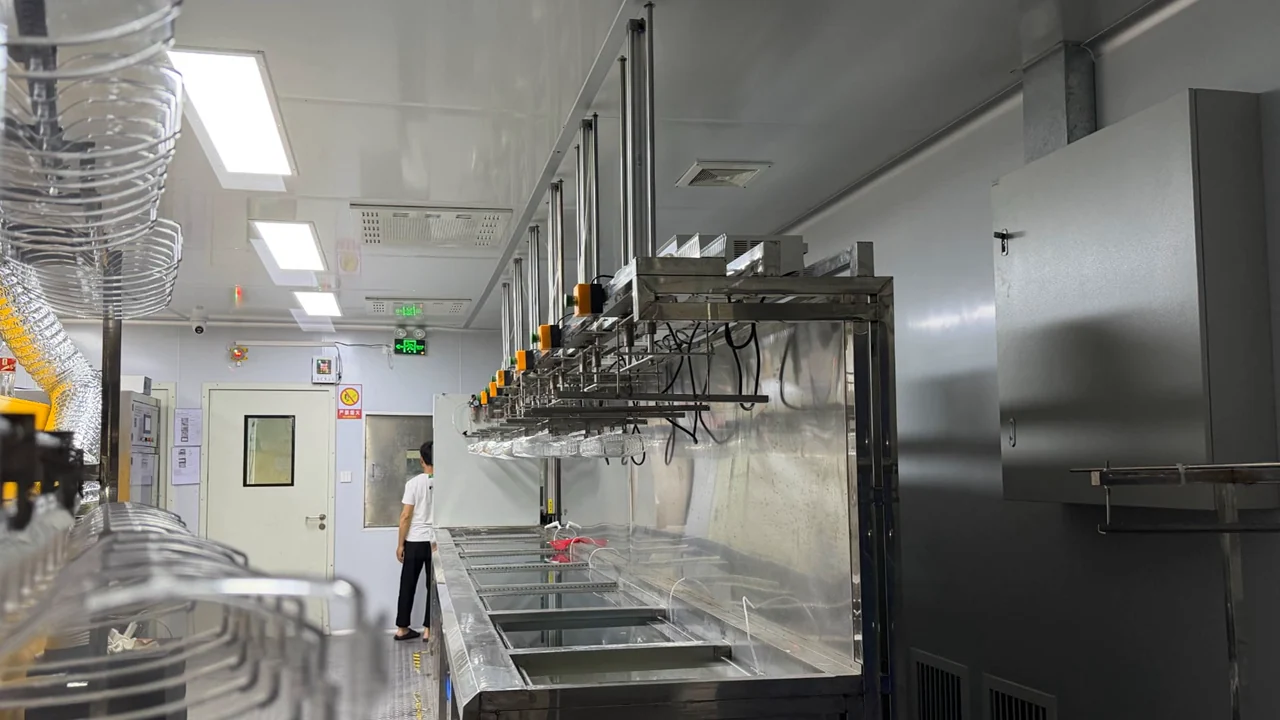
Coating a curved part is not always as straightforward as coating a flat sheet. It requires suitable equipment and careful handling to achieve consistent results. The finished part must also be compatible with the selected coating and curing process.
For a manufacturer without coating equipment, this may mean introducing an external coating partner or purchasing parts that have already been coated.
Cost is another consideration.
With pre-coated sheets, the coating cost is already included in the material. If a part fails during forming, both the coated material and the work completed so far may be lost.
With post-form coating, the factory starts with regular PC, but coating defects can occur after the part has already been formed. A rejected part at this stage may be even more costly.
Neither approach is automatically cheaper.
What matters is how many acceptable parts the factory can consistently produce, how much additional work is required and what each finished part actually costs.
For OEM manufacturers, the cost of a good finished part matters more than the price of any single production step.
A motorcycle helmet visor is a good example of why coating performance alone cannot determine the manufacturing route.
An anti-fog coating may work perfectly on the inner surface, but the visor still needs to provide clear vision. If forming introduces optical distortion or other defects, good anti-fog performance will not make the finished visor acceptable.
The same applies to products that require an anti-fog inner surface and a scratch-resistant outer surface. Both functions matter, but they may not respond to the same manufacturing process in the same way.
And not every application has the same priorities.
An industrial viewing window may need to withstand regular cleaning, while a curved protective cover may place greater emphasis on appearance or resistance to surface damage.
The coating is only one part of the finished product.
Its performance also depends on the PC material, the forming process and how the part will be used and maintained.
This is why testing should go beyond a flat sheet.
A flat sample can show whether a coating provides anti-fog functionality. A representative formed part shows whether that functionality can survive manufacturing and work alongside the other requirements of the product.
For products that are cleaned regularly, it may also be necessary to check whether the anti-fog effect remains acceptable after the expected cleaning routine.
The manufacturing process should serve the finished product, not force the product to accommodate a particular coating method.
PlsTect supplies pre-coated anti-fog polycarbonate sheets and can also help customers evaluate whether coating after forming would be more suitable for their projects.
For manufacturers who already have their own forming equipment and only need functional PC sheets, we can provide material selection guidance and relevant processing support.
There is no need to start by redesigning the entire production process.
A product drawing, an existing forming method or a representative sample can provide a useful starting point. We can first look at whether pre-coated material is likely to work with the customer’s current process.
If it does, the next step is to verify the finished part under representative conditions.
If it does not, we can explore whether a different coating sequence would be more practical.
The objective is to identify a workable approach early, before unnecessary time and cost are committed to a production route that may not be suitable.