

Technical Articles · Anti-Fog Polycarbonate
Anti-fog polycarbonate needs a process-specific review before oven drying and thermoforming. Assess the substrate, coating system, protective film, geometry and finished-part performance together.
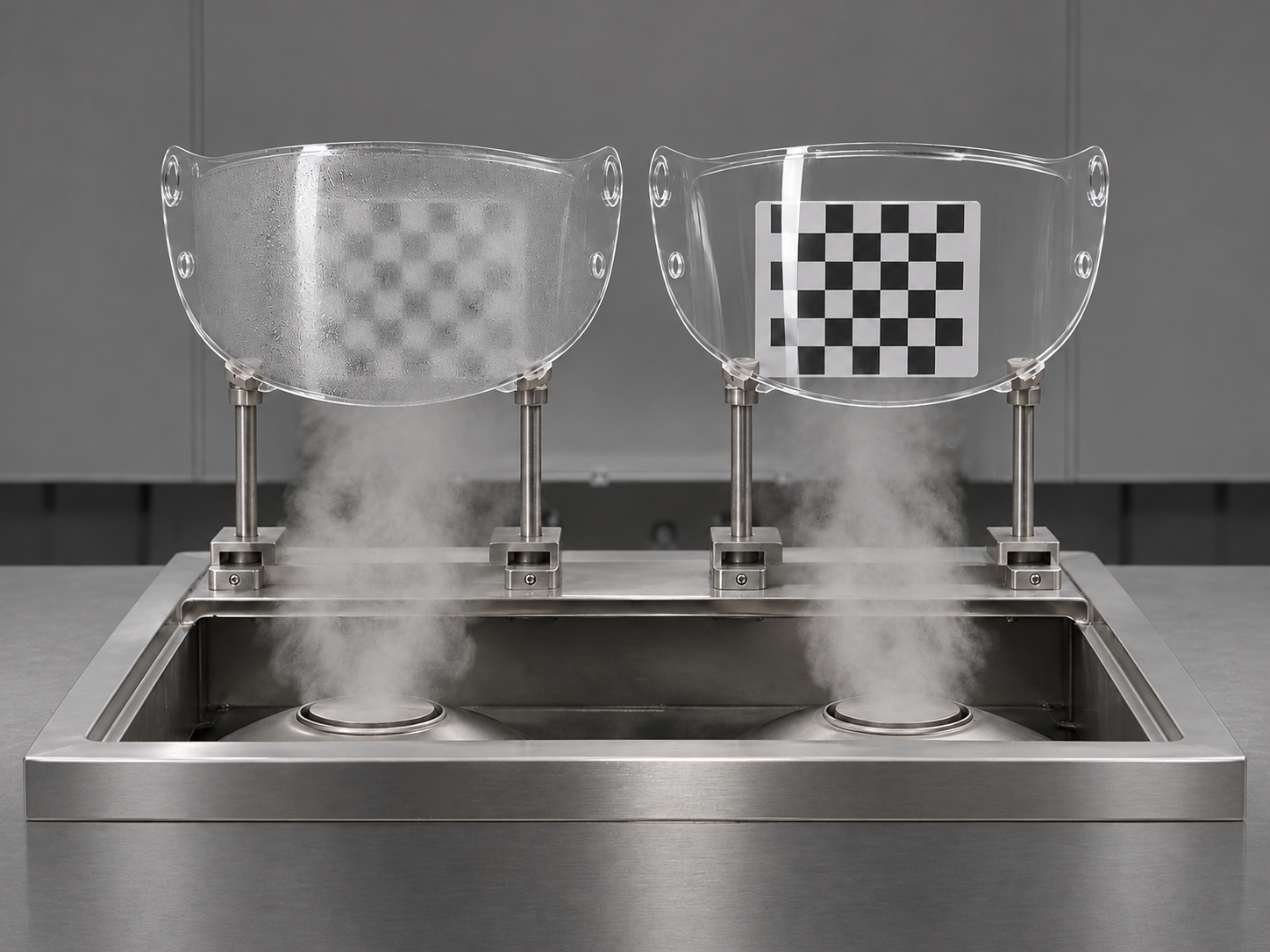
Sometimes—but not by simply copying a standard polycarbonate drying schedule.
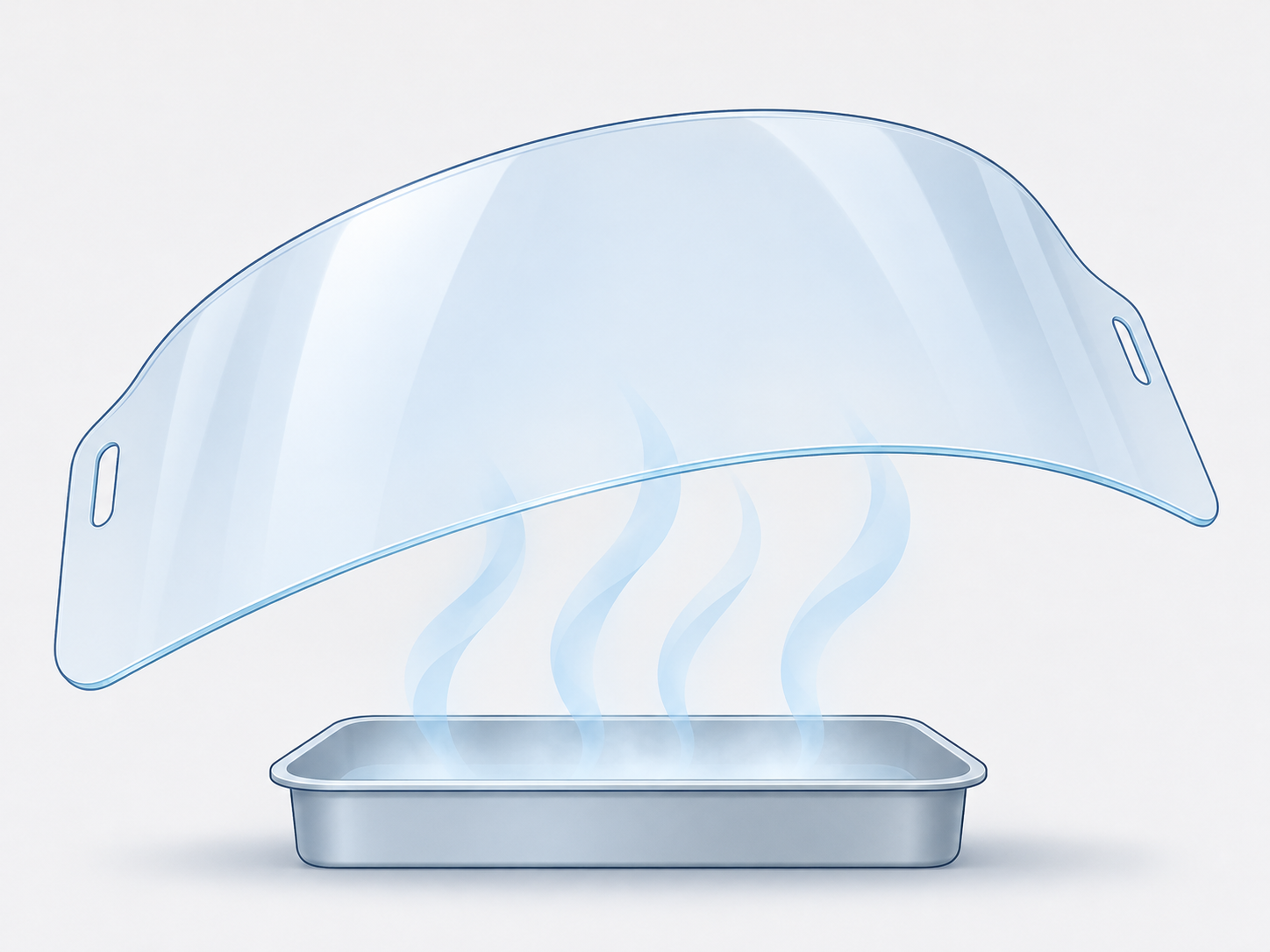
Polycarbonate can absorb moisture during storage. Before high-temperature forming, drying is often used to reduce bubbles and surface defects. Once an anti-fog coating, hard coat or protective film is added, however, the oven cycle no longer affects the substrate alone.
During thermoforming, the complete sheet is heated, stretched, locally thinned, pressed against a mould and cooled into a new geometry. A coating that performs well on a flat sample—or has already completed its own cure—may not respond in the same way after this second heat and deformation cycle.
The practical question is therefore not simply whether PC can be dried. It is whether the full anti-fog polycarbonate construction can retain the required anti-fog, surface and optical performance after the customer’s actual process.
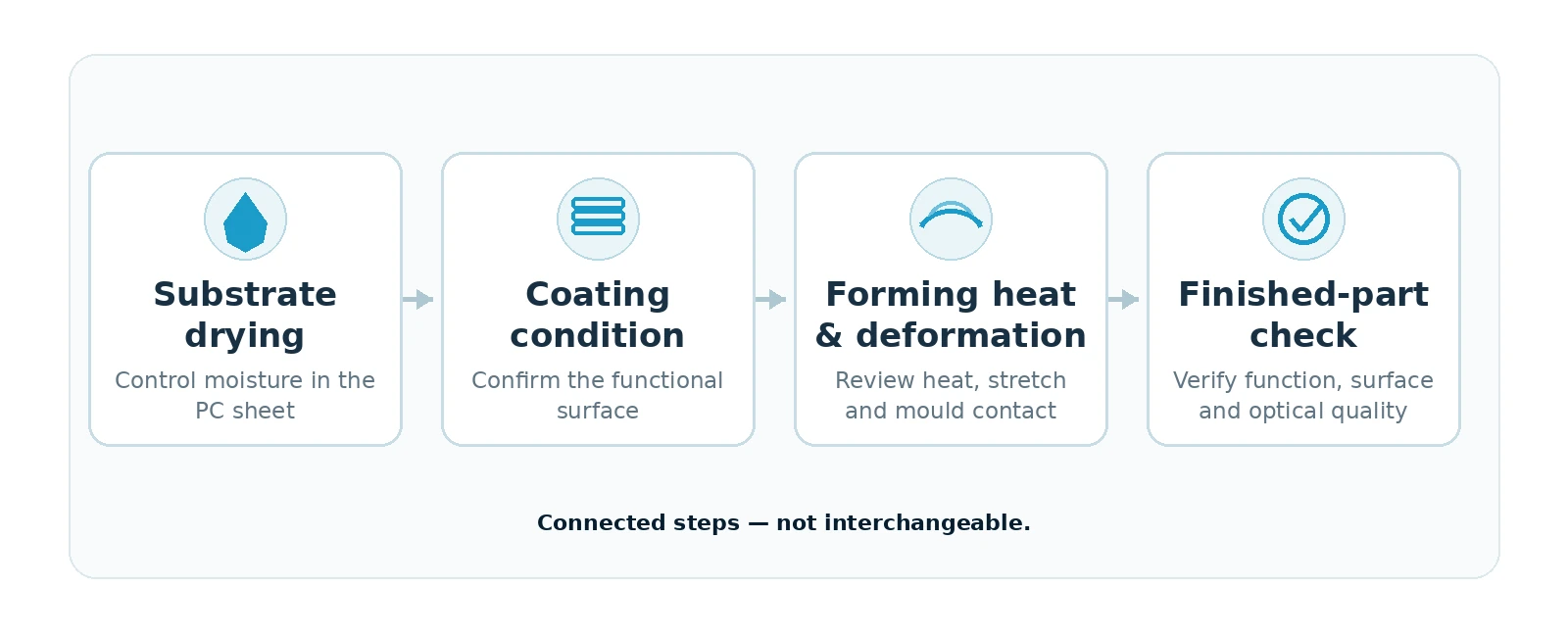
Drying, coating cure and thermoforming may all involve heat, but they serve different purposes. Drying controls moisture in the PC sheet. Coating cure establishes adhesion and surface function. Thermoforming reshapes the complete construction.
This distinction matters when a problem appears. Bubbles may come from residual moisture in the substrate. Surface marks may be linked to protective masking or mould contact. A local change in anti-fog performance may occur only where the part has been stretched more heavily. Treating every defect as “coating failure” can lead to the wrong material or process decision. For a closer review, see why anti-fog performance can change after heating.
Part geometry is just as important as the oven setting. A shallow, repeatable curve may place limited demand on the coating, while a tight radius or local deep draw can concentrate deformation in a small area. That is why a flat-sheet fogging test cannot approve a formed component on its own.
The finished part also has to be judged for more than fog resistance. A visor, instrument cover or transparent viewing panel may remain anti-fog while developing haze, surface waviness, contact marks or visible distortion. Anti-fog performance is one acceptance point, not the whole acceptance decision.
A pre-coated route can be suitable when the coating construction is intended for forming, the geometry is controlled and the process can be repeated consistently. For a two-sided product—such as anti-fog on the inside and abrasion resistance on the outside—both surfaces must be treated as one material structure because they pass through the same heating, handling and forming sequence.
For deep shapes, tight radii, concentrated stretching or demanding viewing areas, applying the anti-fog coating after forming may offer a more controllable route. It avoids stretching the anti-fog layer during shaping, but introduces its own requirements for surface preparation, coating coverage, curing and handling on a three-dimensional part.
Neither route is automatically better. The correct choice is the one that can be sampled, checked and repeated on the finished component.
PlsTect does not separate coated-sheet selection from the process that follows. Material, surface functions, heat history and part geometry are reviewed as one production decision.
An initial review usually starts with a drawing, photograph or reference sample, together with the PC thickness, approximate geometry, planned drying and forming steps, and the function required on each surface. From this information, PlsTect can identify the likely supply route: a forming-compatible coated sheet, coating after forming, a fabricated anti-fog panel or a finished coated component.
The representative sample is then defined around the actual risk. A flat coupon may be enough for an initial coating check, but it cannot represent a highly curved viewing area. Where forming compatibility matters, the sample should reproduce the geometry and deformation that matter to the project.
The checks are also selected around the application. They may include anti-fog response before and after processing, surface condition, haze or transparency, and comparison between lower- and higher-deformation areas. PlsTect’s quality validation approach is intended to make clear what the sample has confirmed and which changes in material, geometry or process would require another review.
The objective is not to label a sheet universally “thermoformable.” It is to establish a defined route, a representative sample and clear processing boundaries before production.
PlsTect also supports formed windshields, windscreens and other curved transparent parts where coating and forming decisions need to be reviewed together.
Share the material thickness, surface requirements, part geometry and planned drying or forming process.
PlsTect will review the likely supply route, the representative sample required and the checks needed before production.
PlsTect supplies plastic, film and glass materials with functional surface treatments and fabrication support for OEM and industrial applications.
From sheets and films to panels, covers, windows and finished components, we help move material requirements toward production-ready parts.
Engineering response within 24 hours
© 2026 PlsTect. All Rights Reserved. Privacy Policy